


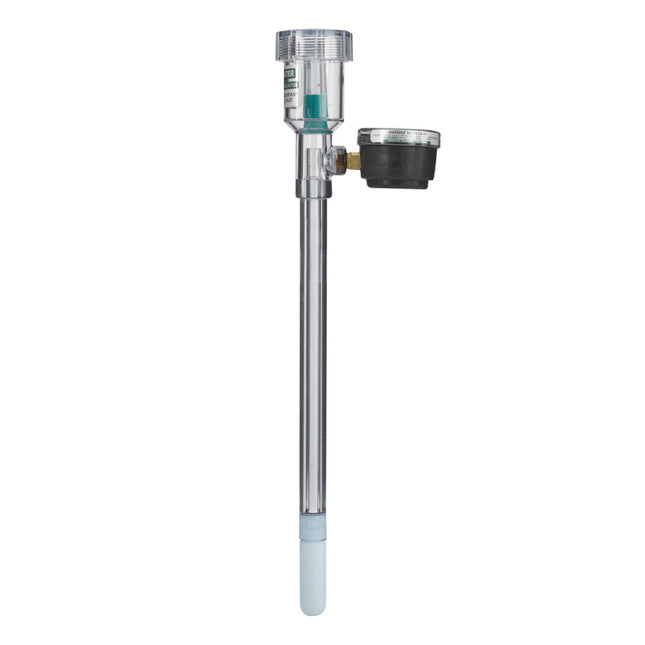
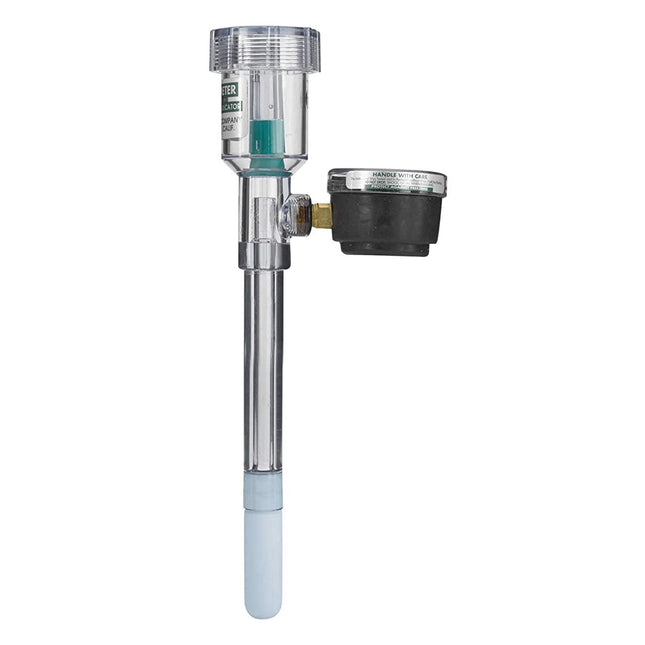
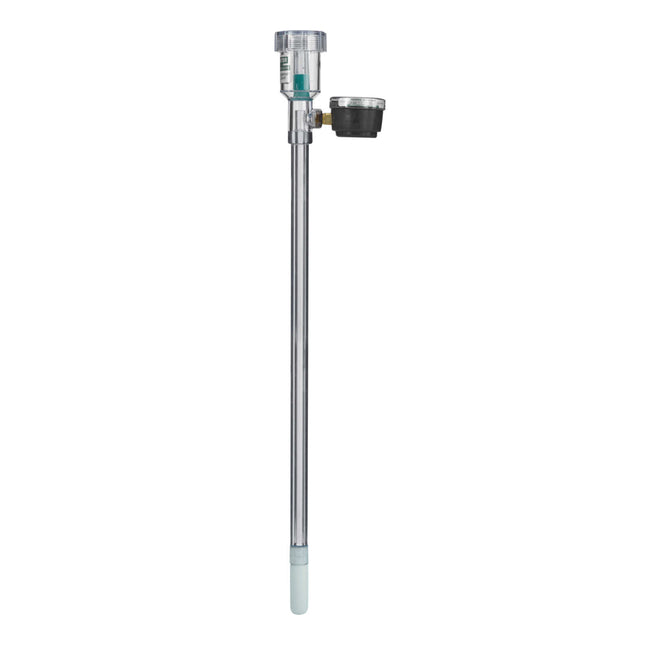
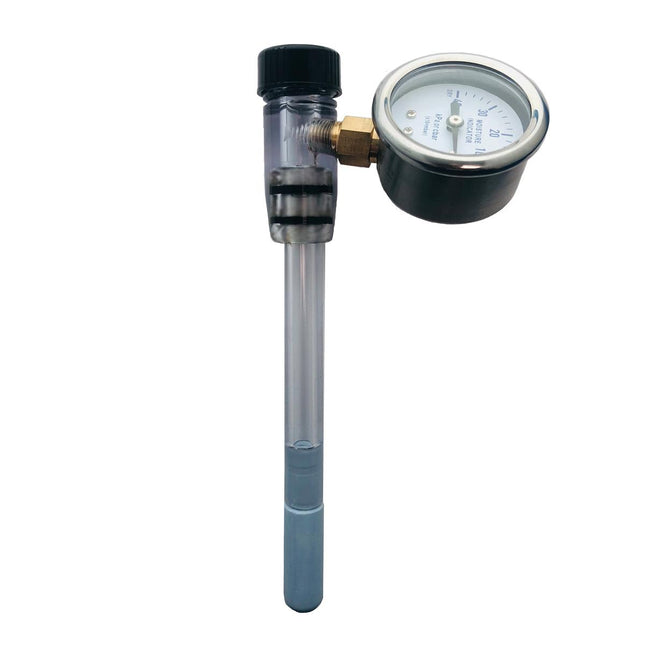
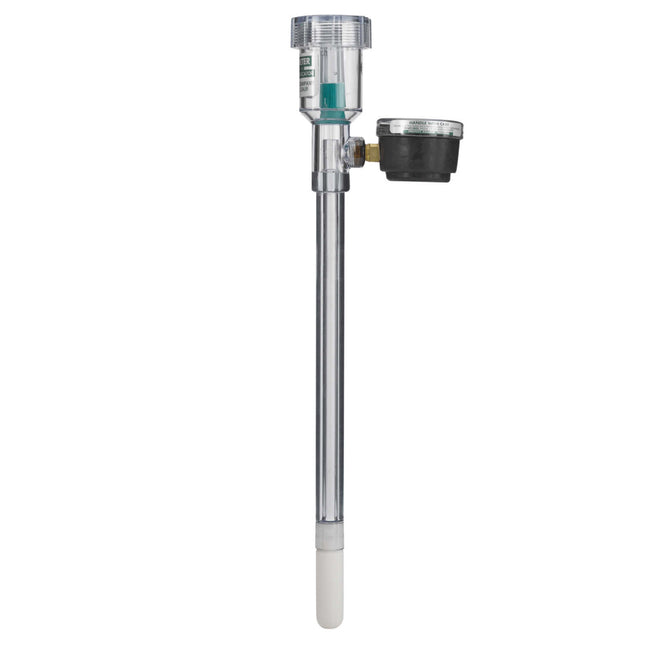
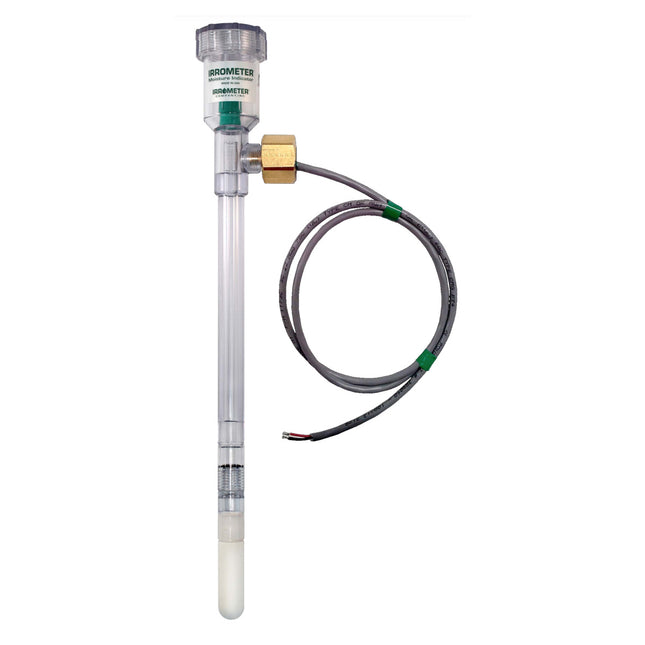
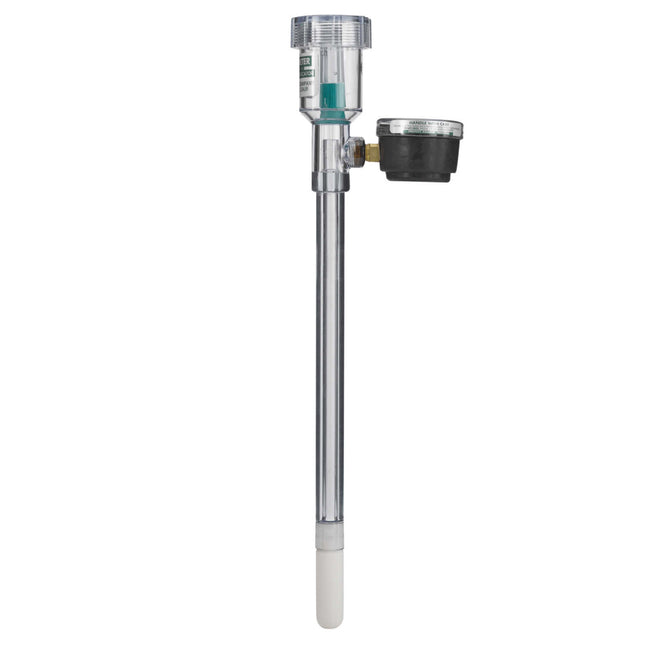
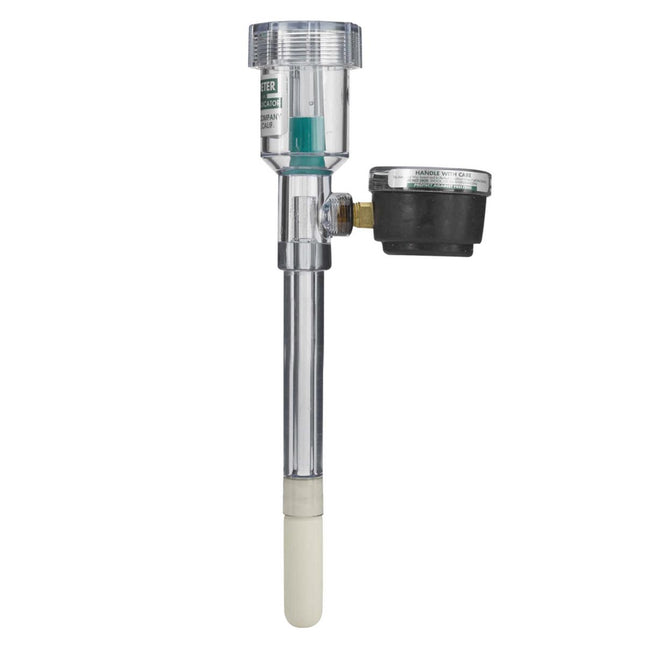
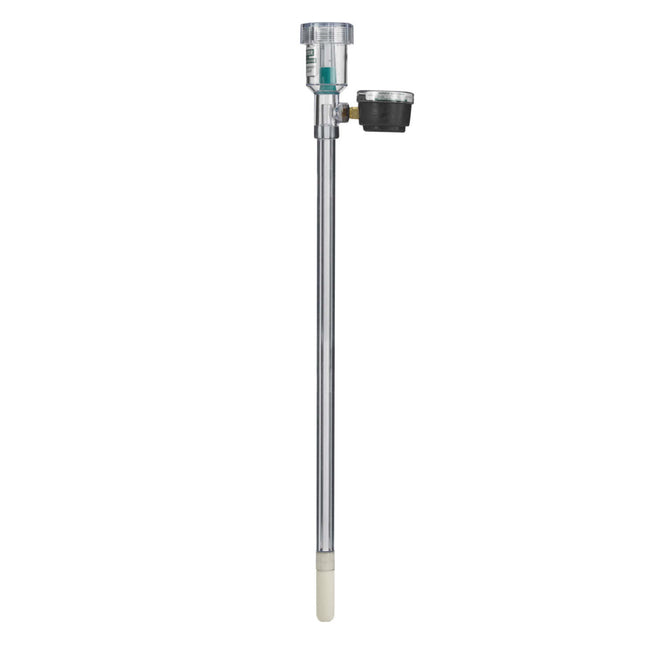

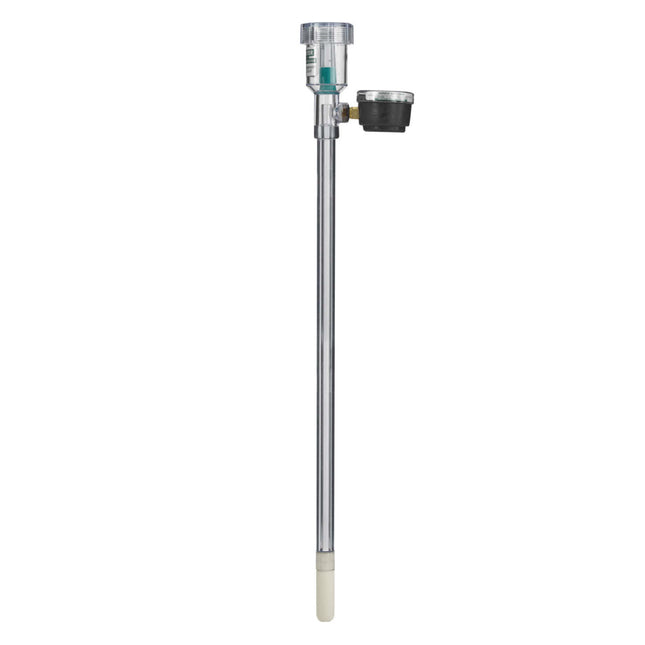
Irrometer tensiometers for directly measuring soil-water tension at different depths in containers, beds, and field soils.
Irrometer Tensiometer

Irrometer Tensiometers
Irrometer tensiometers measure soil water tension, also called soil moisture tension: how hard plant roots have to work to extract water from the soil. The analog gauge provides a continuous, at-a-glance reading without electronics, making it useful for monitoring irrigation and comparing moisture conditions at different depths in the root zone. Want to understand the readings? See our Measuring & Managing Moisture in Living Soil for a deeper explanation of soil moisture tension, mbar/cbar/kPa, sensor placement, volumetric water content (VWC), and using moisture measurements to manage irrigation. Available Options + Choose the model for the soil or growing media you are measuring, then select the length for the depth you want to monitor. Low Tension (LT), 0–40 cbar — for potting mixes, living soil, containers, raised beds, and other relatively wet or coarse growing media. Available in 6″, 12″, and 18″ lengths. Standard (SR), 0–100 cbar — for native and field soils where a wider tension range is useful. Available in 6″, 12″, and 18″ lengths. How It Works + The water-filled Irrometer exchanges moisture through its ceramic tip until it comes into equilibrium with the surrounding soil. As the soil dries, tension inside the instrument increases and the gauge reading rises. After irrigation, the reading falls as the soil becomes wetter. Irrometer gauges read in centibars (cbar). Soil water tension can also be expressed in kilopascals (kPa) or millibars (mbar): 1 cbar = 1 kPa = 10 mbar. Choosing a Length + Length determines the depth of the ceramic tip and therefore the part of the soil profile you are measuring. A 6″ Irrometer monitors closer to the surface, 12″ reaches farther into the root zone, and 18″ is useful in deeper beds or when you want to track moisture movement lower in the soil profile. Using Irrometers at more than one depth can show how deeply an irrigation event recharged the root zone instead of relying on a single measurement near the surface. Service Kit Options + Service kits make setup and maintenance easier by helping pull a vacuum inside the Irrometer. This removes trapped air, helps identify leaks, and speeds instrument response. Both service-kit options include Irrometer fluid/dye and instructions. Basic Service Kit — syringe, fluid/dye, and instructions for a simple way to pull a vacuum. Pump Service Kit — hand pump, fluid/dye, and instructions for faster vacuum service and leak checking. None — Irrometer only. Important Notes + Irrometers must be filled and free of trapped air to respond properly. Good contact between the ceramic tip and the surrounding soil is important for a representative reading. Instrument length affects both measurement depth and the analog reading, so compare readings with the Irrometer length in mind. One service kit can be used to maintain multiple Irrometers.
$108.68 - $119.70
Irrometer Low Tension (LT) Model, 12"
The IRROMETER Model LT (Low Tension) tensiometer was designed to operate in coarse sandy soils and non-soil growing media. With a range of 0-40 centibars (cb) or kilopascals (kPa), this instrument is for use in situations where tensions above 30 cb (kPa) are rarely expected. Gauge increments of 1 cb (kPa) provide a benefit where finer resolution near saturation is needed. This model instrument is also well suited for conditions where rapidly changing soil moisture conditions need to be observed. The "Quick-Flo" ceramic tip is colored blue for easy identification. Model LT IRROMETERS can be used for manual measurement and tracking of soil moisture status in coarse sandy soils and growing media. When equipped with optional electronic output and data logging equipment, measurement and tracking can be done automatically. The low tension vacuum gauge on this model can be replaced with electronic measurement options, or automatic switching devices which can activate peripheral equipment at desired soil water tension levels. See the "Automation and Output Options" specifications for more details. The Model LT is the best choice for container media such as peat, bark, sand, perlite and vermiculite. It can also be used in any soil when the moisture is being managed close to field capacity. Click here for Irrometer's instruction manual.
$115.76
Irrometer Low Tension (LT) Model, 6"
The IRROMETER Model LT (Low Tension) tensiometer was designed to operate in coarse sandy soils and non-soil growing media. With a range of 0-40 centibars (cb) or kilopascals (kPa), this instrument is for use in situations where tensions above 30 cb (kPa) are rarely expected. Gauge increments of 1 cb (kPa) provide a benefit where finer resolution near saturation is needed. This model instrument is also well suited for conditions where rapidly changing soil moisture conditions need to be observed. The "Quick-Flo" ceramic tip is colored blue for easy identification. Model LT IRROMETERS can be used for manual measurement and tracking of soil moisture status in coarse sandy soils and growing media. When equipped with optional electronic output and data logging equipment, measurement and tracking can be done automatically. The low tension vacuum gauge on this model can be replaced with electronic measurement options, or automatic switching devices which can activate peripheral equipment at desired soil water tension levels. See the "Automation and Output Options" specifications for more details. The Model LT is the best choice for container media such as peat, bark, sand, perlite and vermiculite. It can also be used in any soil when the moisture is being managed close to field capacity. Click here for Irrometer's instruction manual.
$111.83
Irrometer Low Tension (LT) Model, 18"
The IRROMETER Model LT (Low Tension) tensiometer was designed to operate in coarse sandy soils and non-soil growing media. With a range of 0-40 centibars (cb) or kilopascals (kPa), this instrument is for use in situations where tensions above 30 cb (kPa) are rarely expected. Gauge increments of 1 cb (kPa) provide a benefit where finer resolution near saturation is needed. This model instrument is also well suited for conditions where rapidly changing soil moisture conditions need to be observed. The "Quick-Flo" ceramic tip is colored blue for easy identification. Model LT IRROMETERS can be used for manual measurement and tracking of soil moisture status in coarse sandy soils and growing media. When equipped with optional electronic output and data logging equipment, measurement and tracking can be done automatically. The low tension vacuum gauge on this model can be replaced with electronic measurement options, or automatic switching devices which can activate peripheral equipment at desired soil water tension levels. See the "Automation and Output Options" specifications for more details. The Model LT is the best choice for container media such as peat, bark, sand, perlite and vermiculite. It can also be used in any soil when the moisture is being managed close to field capacity. Click here for Irrometer's instruction manual.
$119.70
Irrometer Miniature Low Tension (MLT) Model
The IRROMETER Model MLT (Miniature Low Tension) tensiometer was designed for use in small containers commonly used in greenhouses and nurseries. Its compact design and short insertion depth of 4.75 inches (12 cm) allows the MLT to be installed in smaller growing vessels. With a range of 0-40 centibars (cb) or kilopascals (kPa), this instrument is for use in situations where tensions above 30 cb (kPa) are rarely expected. Gauge increments of 1 cb (kPa) provide a benefit where finer resolution near saturation is needed. This model instrument is also well suited for conditions where rapidly changing soil moisture conditions need to be observed. The "Quick-Flo" ceramic tip is colored blue for easy identification Click here for Irrometer's instruction manual.
$94.50
Irrometer Standard (SR) Model, 12"
OPERATING PRINCIPLE: The IRROMETER operates on the tensiometer principle, which measures soil water tension. Soil water tension is the energy (vacuum) applied to soil by the plant as it draws in water for nutrition. This force is measured in centibars (cb) or kilopascals (kPa) of tension with a high reading indicating the dry end of the scale and a low reading indicating the wet end of the scale. The IRROMETER instrument consists of a sealed, fluid filled tube that is equipped with a porous ceramic tip and a special vacuum gauge. They are installed in the ground with the tips placed at desired root zone depths. As the soil dries (increasing tension), fluid is drawn out of the instrument. This reduces the fluid volume in the IRROMETER, thus creating a partial vacuum which is registered on the gauge. The drier the soil, the higher the gauge reading. An irrigation application or rainfall event reverses this action. As water flows back into the soil (and the IRROMETER), tension is relieved in the soil and the instrument, resulting in a lower gauge reading (lower tension). In effect, the instrument is indicating how hard the roots are working. Due to the IRROMETER’s unique principle of operation, no calibrations are necessary under normal operating conditions for different soil types. A gauge reading of 50 cb (kPa) indicates that the roots are extracting the same amount of moisture whether the crop is planted in sandy soil or clay soil. Click here for Irrometer's instruction manual.
$112.61
Voltage Irrometer 12"
Information you can use, when you need itMeasure the soil moisture available for your plants and automatically transmit to an IrroCloud Monitor. This tensiometer measures moisture levels in centibars and gives you the same information as typical analog versions you have to see in person. You can hook up to 6 of these to every IrroCloud Monitor and see the data on your smart phone, desk computer, or laptop anywhere in the world. The user-friendly IrroCloud software lets you see the data in many ways—graphs, averages, individual sites, rain events, and several other useful configurations, turning the data into actionable information.
$180.86
Irrometer Standard (SR) Model, 18"
OPERATING PRINCIPLE: The IRROMETER operates on the tensiometer principle, which measures soil water tension. Soil water tension is the energy (vacuum) applied to soil by the plant as it draws in water for nutrition. This force is measured in centibars (cb) or kilopascals (kPa) of tension with a high reading indicating the dry end of the scale and a low reading indicating the wet end of the scale. The IRROMETER instrument consists of a sealed, fluid filled tube that is equipped with a porous ceramic tip and a special vacuum gauge. They are installed in the ground with the tips placed at desired root zone depths. As the soil dries (increasing tension), fluid is drawn out of the instrument. This reduces the fluid volume in the IRROMETER, thus creating a partial vacuum which is registered on the gauge. The drier the soil, the higher the gauge reading. An irrigation application or rainfall event reverses this action. As water flows back into the soil (and the IRROMETER), tension is relieved in the soil and the instrument, resulting in a lower gauge reading (lower tension). In effect, the instrument is indicating how hard the roots are working. Due to the IRROMETER’s unique principle of operation, no calibrations are necessary under normal operating conditions for different soil types. A gauge reading of 50 cb (kPa) indicates that the roots are extracting the same amount of moisture whether the crop is planted in sandy soil or clay soil. Click here for Irrometer's instruction manual.
$116.55
Irrometer Standard (SR) Model, 6"
OPERATING PRINCIPLE: The IRROMETER operates on the tensiometer principle, which measures soil water tension. Soil water tension is the energy (vacuum) applied to soil by the plant as it draws in water for nutrition. This force is measured in centibars (cb) or kilopascals (kPa) of tension with a high reading indicating the dry end of the scale and a low reading indicating the wet end of the scale. The IRROMETER instrument consists of a sealed, fluid filled tube that is equipped with a porous ceramic tip and a special vacuum gauge. They are installed in the ground with the tips placed at desired root zone depths. As the soil dries (increasing tension), fluid is drawn out of the instrument. This reduces the fluid volume in the IRROMETER, thus creating a partial vacuum which is registered on the gauge. The drier the soil, the higher the gauge reading. An irrigation application or rainfall event reverses this action. As water flows back into the soil (and the IRROMETER), tension is relieved in the soil and the instrument, resulting in a lower gauge reading (lower tension). In effect, the instrument is indicating how hard the roots are working. Due to the IRROMETER’s unique principle of operation, no calibrations are necessary under normal operating conditions for different soil types. A gauge reading of 50 cb (kPa) indicates that the roots are extracting the same amount of moisture whether the crop is planted in sandy soil or clay soil. Click here for Irrometer's instruction manual.
$108.68
Irrometer Standard (SR) Model, 24"
OPERATING PRINCIPLE: The IRROMETER operates on the tensiometer principle, which measures soil water tension. Soil water tension is the energy (vacuum) applied to soil by the plant as it draws in water for nutrition. This force is measured in centibars (cb) or kilopascals (kPa) of tension with a high reading indicating the dry end of the scale and a low reading indicating the wet end of the scale. The IRROMETER instrument consists of a sealed, fluid filled tube that is equipped with a porous ceramic tip and a special vacuum gauge. They are installed in the ground with the tips placed at desired root zone depths. As the soil dries (increasing tension), fluid is drawn out of the instrument. This reduces the fluid volume in the IRROMETER, thus creating a partial vacuum which is registered on the gauge. The drier the soil, the higher the gauge reading. An irrigation application or rainfall event reverses this action. As water flows back into the soil (and the IRROMETER), tension is relieved in the soil and the instrument, resulting in a lower gauge reading (lower tension). In effect, the instrument is indicating how hard the roots are working. Due to the IRROMETER’s unique principle of operation, no calibrations are necessary under normal operating conditions for different soil types. A gauge reading of 50 cb (kPa) indicates that the roots are extracting the same amount of moisture whether the crop is planted in sandy soil or clay soil. Click here for Irrometer's instruction manual.
$120.49

Voltage Irrometer 6"
Description Fast shallow-soil information when you need itLike the 12" version, this 6" sensor measures soil moisture and transmits it to an IrroCloud Monitor. Because this one is closer to the soil surface, it works best for plants with shallow roots and for large plants when they're still small. Hook up 1-6 of these for every IrroCloud Monitor you have or plan to get and automatically have all this critical information on your phone or computer. You can also install a combination of 6" and 12" sensors on the same system with the same simple software, accuracy, graphs, averages, and configurations.
$176.93
Irrometer Standard (SR) Model, 36"
Description OPERATING PRINCIPLE: The IRROMETER operates on the tensiometer principle, which measures soil water tension. Soil water tension is the energy (vacuum) applied to soil by the plant as it draws in water for nutrition. This force is measured in centibars (cb) or kilopascals (kPa) of tension with a high reading indicating the dry end of the scale and a low reading indicating the wet end of the scale. The IRROMETER instrument consists of a sealed, fluid filled tube that is equipped with a porous ceramic tip and a special vacuum gauge. They are installed in the ground with the tips placed at desired root zone depths. As the soil dries (increasing tension), fluid is drawn out of the instrument. This reduces the fluid volume in the IRROMETER, thus creating a partial vacuum which is registered on the gauge. The drier the soil, the higher the gauge reading. An irrigation application or rainfall event reverses this action. As water flows back into the soil (and the IRROMETER), tension is relieved in the soil and the instrument, resulting in a lower gauge reading (lower tension). In effect, the instrument is indicating how hard the roots are working. Due to the IRROMETER's unique principle of operation, no calibrations are necessary under normal operating conditions for different soil types. A gauge reading of 50 cb (kPa) indicates that the roots are extracting the same amount of moisture whether the crop is planted in sandy soil or clay soil. Click here for Irrometer's instruction manual.
$128.36
What Growers Are Saying


